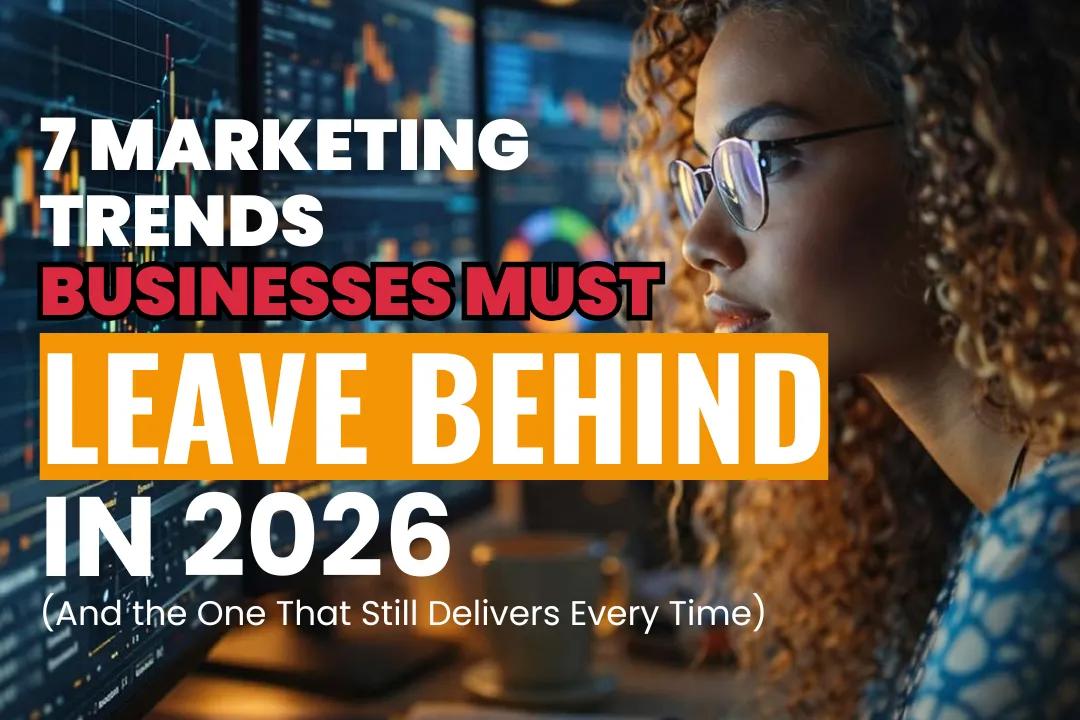
7 Marketing Trends Businesses Must Leave Behind in 2026
Every year, marketing adds more tools, more platforms, more “opportunities.” But almost no one talks about the harder move — letting things go.
Not because they’re new.
Not because they’re exciting.
But because they quietly stopped earning their keep.
Most businesses don’t fail at marketing because they aren’t trying hard enough. They fail because they’re still funding strategies that made sense five or six years ago — and feel productive — but no longer match how attention, trust, or buying decisions actually work.
Here’s the uncomfortable part: a lot of these tactics didn’t suddenly break. They slowly decayed. Just enough to stay believable. Just enough to avoid scrutiny.
Some marketing trends don’t die — they just refuse to leave. But the numbers don’t lie anymore. What worked in 2018–2022 is now actively holding businesses back in 2026.
This isn’t a list of what’s “out.” It’s a reality check on what businesses need to move on from — permanently — if they want growth that actually compounds.
Trend #1 to Leave Behind: Organic Social Media as a Lead Source
This is the big one — and the most misunderstood.
Posting consistently on Facebook, Instagram, or LinkedIn does not equal lead generation anymore. That doesn’t mean organic social is useless. It means its role has changed.
Organic posts today serve as validation content, brand reinforcement, and light engagement for people already aware of you. What they are not is a reliable way to reach new buyers.
If a business is still expecting organic posts to drive steady traffic, inquiries, or bookings, it’s building on false assumptions. Platforms are engineered to limit business visibility unless money is involved.
What to do instead: Use organic social to support paid campaigns, retargeting, and credibility checks — not as the primary acquisition channel.
Trend #2 to Leave Behind: “Set It and Forget It” Google Ads
Automation didn’t ruin Google Ads. Complacency did.
Too many businesses turned on Smart campaigns, Performance Max, or auto-bidding and assumed the machine would handle the rest. What actually happened was spend increased while efficiency quietly eroded.
Automation doesn’t understand business margins, lead quality, local nuance, or seasonality beyond surface trends. It optimizes toward signals — not outcomes.
What to do instead: Use automation with guardrails. Actively review search terms, conversion quality, and cost per real lead — not just platform-reported success.
Trend #3 to Leave Behind: SEO Built Only Around Keywords
Ranking for keywords is no longer the win it once was.
Between AI Overviews, zero-click searches, local packs, and featured snippets, a top ranking does not guarantee traffic — and traffic doesn’t guarantee intent.
Many businesses are still investing in SEO content that answers questions without guiding action, ranks but doesn’t convert, or attracts the wrong stage of buyer. That’s not SEO strategy. That’s content volume.
What to do instead: Optimize around search intent and decision paths, not just keywords. Pages should move users toward a decision, not just inform them.
Trend #4 to Leave Behind: “Full-Service” / Generic Positioning
“We do it all.”
“No matter what you need… We can help!”
“We offer A-Z solutions.”
This messaging isn’t just boring — it’s actively hurting conversion.
In crowded markets, buyers don’t want flexibility. They want clarity. Generic positioning forces prospects to do the work of figuring out why one option is better than another. Most won’t bother.
What to do instead: Narrow the message. Speak to a specific problem, industry, or outcome. Clarity outperforms breadth every time.
Trend #5 to Leave Behind: Vanity Metrics as Success Indicators
Impressions, reach, followers, and likes are not inherently bad. They’re just not proof of performance.
The problem is when businesses use these numbers to justify spend without tying them to outcomes. It creates a false sense of progress while revenue stays flat.
In 2026, this is no longer acceptable — especially with tighter budgets and higher competition.
What to do instead: Track metrics that connect to real movement: inquiries, booked calls, qualified leads, pipeline value, and closed revenue.
Trend #6 to Leave Behind: Copy-and-Paste Marketing
Funnels, ads, landing pages, and content formats get copied because it feels safer than thinking.
But execution without context is why so many “proven systems” stop working the moment they leave their original environment. Markets mature. Audiences get smarter. What once converted quickly now feels familiar — or worse, manipulative.
What to do instead: Borrow frameworks, not execution. Adapt ideas to your market, audience awareness level, and offer maturity.
Trend #7 to Leave Behind: Platform-First Strategy
“Should we focus on TikTok?”
“Should we be on Instagram more?”
“Should we try YouTube Shorts?”
These questions put the platform before the buyer.
Platforms change faster than buying behavior. When strategy is built around a single channel, growth becomes fragile — and every algorithm update feels existential.
What to do instead: Build strategy around how customers discover, evaluate, and decide — then choose platforms that support that journey.
The ONE Trend That Still Works Like Clockwork
Now the exception.
The trend that hasn’t weakened — and arguably matters more in 2026 than ever — is educational, decision-driven marketing.
Not content for engagement. Not thought leadership fluff. Not vague “value posts.”
Clear explanations that help buyers understand their problem, their options, the trade-offs, what choosing wrong looks like, and what choosing right actually delivers.
This works because it removes uncertainty — the number one blocker in modern buying decisions.
Businesses that educate properly shorten sales cycles, reduce price resistance, attract more qualified leads, and build trust before the first conversation.
This approach works on websites, landing pages, email, ads, social, and search. That’s why it refuses to die. It was never a trend — it was alignment with how people actually buy.
The Real Takeaway for 2026
Growth isn’t about adding more tactics. It’s about funding fewer, better ones.
Businesses that keep clinging to outdated strategies don’t fail immediately — they just stall while competitors move past them.
Letting go isn’t a loss. It’s a reallocation.
And in 2026, the businesses willing to move on decisively are the ones that stop wasting effort and start seeing compounding returns again.